IR Remote based firing angle control of Triac |
Introduction: |
|
The purpose of this project is to design a system that can be used to control the firing angle of any AC motor. So we can control the speed of the motor easily while sitting on a sofa. The speed can be controlled in 10 steps and the Remote has a distance of 5-10m. |
|
The presence of AC appliances (fan / Light) in a house or office is not now considered as a luxury on the other hand it is included in the basic requirement. The uses of new electronic theories have been put down by expertise to increase the facilities given by the existing appliance. Here the facility of ordinary AC appliances is increased by the making it controlled remotely through IR Remote. |
|
This introductory part explains about the motivation to build this project, a short history of remote control world. We know now a day’s technology so improving that workload of man is decrease. On sitting on sofa we operate T.V, A.C. & other equipments. On same fashion we construct here receiving circuit which operates on Infrared remote. We can operate any AC motor by remote provided that this circuit must place in that device. The range of remote is 36fts in this range when you push the button device gets on-off according to our requirement. We can even control the speed of the motor. If we connect this circuit to a bulb we can even control the bulb intensity according to the switch pressed. |
Block Diagram: |
|
|
|
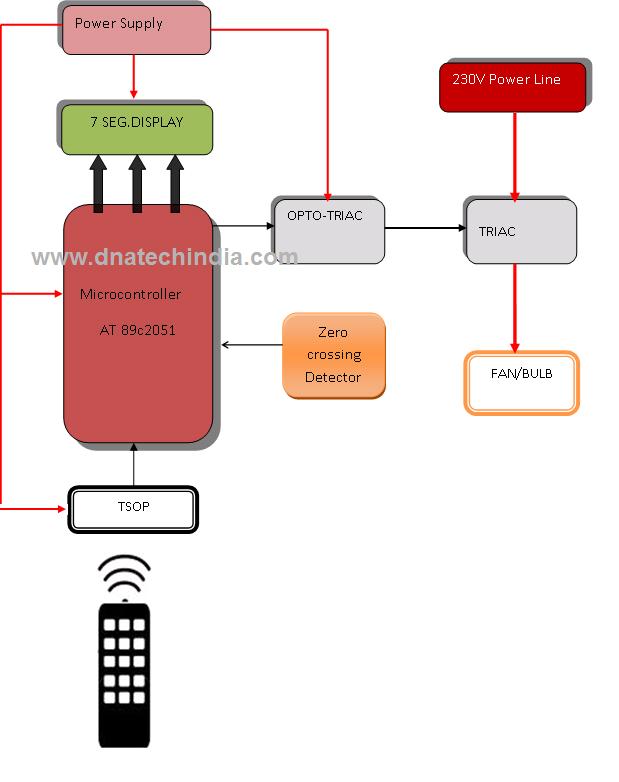
In this project we will be using 89c2051 which is a 20 pin microcontroller. The controller is heart of the project and performs all the necessary action. |
|
A TSOP sensor is used as an IR receiver. It basically takes the modulated IR signal from the remote and then gives it to the controller in digital form. The controller then decodes the received signal and accordingly takes necessary action. A seven segment display is used to display the motor speed and will accordingly display from 0-9. If the motor is off it will display ‘-‘. |
|
A Zero Crossing Detector (ZCD) is used to detect zero crossings of the mains AC supply. A opto-triac is used for Isolation between the 230V operated Triac and the 5v based controller circuit. The opto-triac provides the necessary gate current and gate voltage required for the Triac. |
Hardware Requirement: |
|
Software Requirement: |
|
Advantages: |
|
Disadvantages: |
|
Text Books: |
|
Website: |
Magazines: |
|
IR Remote based firing angle control of Triac